Compare nominal and absolute micron claims using Beta ratio, efficiency and ISO 16889:2022 test context before specifying a hydraulic filter.
“Ten micron” looks like a complete specification. On its own, it is not.
The number tells you a particle size. It does not tell you what share of particles at or above that size a hydraulic filter captures, how the result was tested or whether the claim belongs to the exact element being quoted. Add nominal or absolute and the label still needs a definition; manufacturers do not always use those words at the same efficiency threshold.
The cleanest way to compare two claims is to split each one into three fields:
- Particle size — for example, x µm(c).
- Removal performance — a Beta ratio or stated efficiency at that size.
- Test context — method, edition, exact element and conditions.
This guide explains how to do that with ISO 16889:2022 as the current multi-pass reference. It does not select a filter, approve an interchange or replace the equipment manufacturer's cleanliness and operating requirements.
What each label actually tells you
| Label on a page or quote | What it actually tells you | What is still missing |
|---|---|---|
| 10 µm | A particle-size value | Efficiency, test method and exact tested configuration |
| 10 µm nominal | A manufacturer-described nominal grade | That manufacturer's definition and supporting test data |
| 10 µm absolute | A manufacturer-described absolute grade | The efficiency threshold, method and conditions behind “absolute” |
| β10(c) = 200 | Upstream count is 200 times downstream count at and above 10 µm(c) under the stated test | Test method, element identity and conditions; mathematically this is 99.5% efficiency |
| β10(c) = 1000 | Upstream count is 1,000 times downstream count at and above 10 µm(c) under the stated test | The same context; mathematically this is 99.9% efficiency |
The last two rows show the arithmetic only; they are not OXELR product claims. A Beta expression tells you much more than a bare micron label, but it still has to stay attached to its evidence.
“Nominal” and “absolute” are not a common yardstick
In everyday filtration language, nominal usually suggests a lower or less tightly defined removal level, while absolute suggests a higher cutoff or efficiency. That is useful as a rough reading. It is nowhere near enough for a purchase order.
Manufacturer publications show why. A Donaldson technical article describes nominal as generally corresponding to Beta 2, or about 50% efficiency, and absolute as generally Beta 75, or about 98.7%. The Parker Handbook of Hydraulic Filtration bases one media-selection method on “absolute” ratings at Beta 200 or higher, equivalent to 99.5% efficiency or better. These are two manufacturers' stated conventions, not values to blend into a universal definition.
If one quote says “10 micron absolute” and another says “10 micron nominal,” the adjectives do not tell you which filter removes more. Ask both suppliers for the Beta ratio at the stated particle size, the test method and the part-specific report. Until those fields are filled, the comparison stays pending.
Beta ratio puts an efficiency beside the particle size
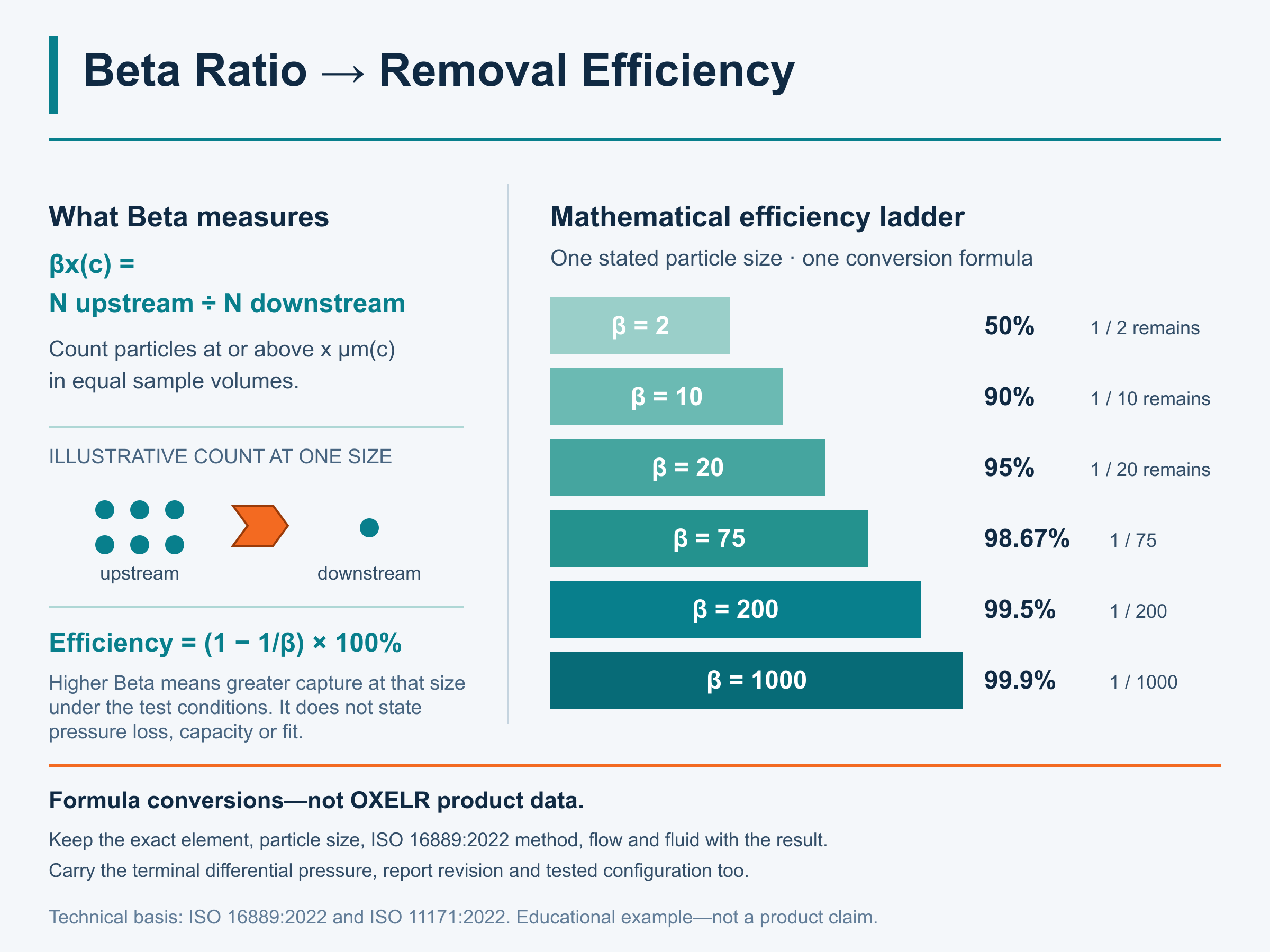
The filtration ratio compares particle counts upstream and downstream of the test element at or above one stated size. It is commonly written as:
βx(c) = upstream particle count ≥ x µm(c) ÷ downstream particle count ≥ x µm(c)
The corresponding efficiency is:
Efficiency = (1 − 1 ÷ β) × 100%
Here are the mathematical conversions most often useful when reading a report:
| Beta ratio at one stated size | Calculated efficiency at that same size |
|---|---|
| 2 | 50% |
| 10 | 90% |
| 20 | 95% |
| 75 | 98.67% |
| 100 | 99% |
| 200 | 99.5% |
| 1000 | 99.9% |
A higher Beta value means greater removal efficiency at that stated particle size under the test conditions. It does not make the filter better in every respect. By itself, it says nothing about pressure loss, contaminant capacity, structural limits, seal compatibility or suitability for the circuit.
The particle-size subscript matters too. β10(c) and β20(c) describe different points on the performance curve. Dropping the subscript and writing only “Beta 200” removes the size being measured. Likewise, moving a Beta value from one media grade or element to a neighboring catalog item is not acceptable evidence.
Keep the “(c)” attached to the number
The “(c)” notation identifies particle sizing tied to calibrated automatic particle counting. The current ISO 11171:2022 specifies calibration procedures for liquid automatic particle counters, including primary particle-sizing calibration at 1 µm(c) and larger.
The notation is not decoration. Older data reported on a different calibration basis is not automatically interchangeable with µm(c) data merely because both use the word micron. When an older drawing is compared with a current report, keep the calibration basis and test standard beside the result.
ISO 16889 gives you a test method, not a machine approval
ISO lists ISO 16889:2022, Edition 3 as the published current edition. Its public scope describes a multi-pass test with continuous contaminant injection for hydraulic fluid-power filter elements. The procedure determines particulate-removal, contaminant-capacity and differential-pressure characteristics under controlled conditions.
In purchasing terms, the laboratory circulates fluid, adds defined contaminant, counts particles upstream and downstream, and records how the element behaves as it loads. That creates a common test framework. It cannot recreate every machine, cold start, flow transient, fluid chemistry or maintenance condition.
The Donaldson Hydraulic Filtration Overview makes two practical cautions: ISO 16889 results depend on the tested configuration and conditions, and Beta ratings are laboratory measurements under controlled flow with artificial contaminant. It also notes that manufacturers can test at different flow rates and terminal pressure-drop settings permitted by the method. The Parker handbook adds the field-side warning: flow and viscosity affect pressure differential and element life, so pressure-drop and life comparisons need the same operating basis.
So “tested to ISO 16889” is the beginning of the evidence check, not the end. Ask for:
- The exact element part number, media code and tested configuration.
- The standard and edition cited by the report.
- Beta values at the relevant µm(c) sizes, not a detached marketing headline.
- Test flow rate, fluid and viscosity information.
- Initial and terminal differential-pressure conditions.
- Contaminant capacity and how the endpoint was defined.
- Report number, revision, laboratory identity and issue date.
Then compare those fields with the equipment or system owner's requirements. The standard provides a repeatable method for evaluating an element; it does not choose the required micron grade for a machine.
Put both data sheets on the same basis
Give every claim its own row. If a cell is blank, leave it unresolved; do not turn it into an assumed match.
| Comparison field | Candidate A | Candidate B | Evidence required |
|---|---|---|---|
| Exact element and media code | Part-specific manufacturer document | ||
| Particle size | Value written in µm(c) or clearly identified alternative basis | ||
| Beta ratio | Beta value at that same particle size | ||
| Calculated or stated efficiency | Must agree with the Beta value | ||
| Test standard and edition | Full method citation | ||
| Test flow and fluid/viscosity | Test report or technical datasheet | ||
| Initial and terminal differential pressure | Named test conditions, not housing working pressure | ||
| Contaminant capacity | Result and endpoint from the same test basis | ||
| Report revision and date | Traceable source for the exact element | ||
| Application acceptance | Equipment-OEM or authorized system-owner decision |
Do not average mismatched rows. A nominal label on Candidate A cannot be compared directly with a Beta result on Candidate B. An older µm value cannot silently become µm(c). A result for a media family cannot automatically fill the row for every element that uses a similar name.
Smaller microns do not automatically mean a better choice
A finer efficiency point can be attractive, but a hydraulic system has more than one requirement. Flow, viscosity, cold-start behavior, initial pressure drop, dirt loading, element structure, housing design and bypass arrangement all interact. A filter selected only for the smallest number on a label may add restriction or behave differently as it loads.
The system owner should establish the required cleanliness target and operating envelope. The supplier's job is to show how the exact offered element performs within that envelope. The buyer's job is to keep the evidence and approval attached to the part number.
Use the public hydraulic filter range to identify possible product families, not to infer a performance value that is not documented on a current manufacturer record.
Make unsupported values visible in the RFQ
Give the supplier enough context to answer with evidence, not another shorthand label:
- Source part number, manufacturer and equipment application.
- Circuit duty and filter location supplied by the system owner.
- Required particle size and minimum Beta ratio at that size.
- Required test method and acceptable edition.
- Flow, fluid, viscosity and temperature range.
- Clean-element pressure-drop limit and the conditions at which it applies.
- Required contaminant capacity or service objective, if defined by the equipment owner.
- Structural, bypass, seal and compatibility requirements kept in their own fields.
- Documents required with the quote: drawing, datasheet, test report and approval status.
- A clear pending status for any unsupported value.
You can send OXELR a filter RFQ with those fields. OXELR can state what is documented for an offered part. Technical acceptance remains with the equipment OEM or authorized system owner.
Make the comparison stand without the adjectives
Before choosing between two offers, set nominal and absolute aside for a moment. The remaining evidence should still show particle size, Beta ratio or efficiency, test method, exact element and test conditions. If the comparison falls apart without the adjective, the specification is not ready.
For example, β10(c) = 200 means that, under the stated test, the upstream count of particles at or above 10 µm(c) was 200 times the downstream count. The mathematical efficiency is 99.5% at that size. That statement only becomes a product claim when current evidence for the exact offered element supports it.
The same discipline applies to a 5-micron label beside a 10-micron label. Five is the smaller particle-size number, but efficiency and test basis are still missing. A 5 µm nominal claim and a β10(c) = 1000 result cannot be ranked from 5 and 10 alone; compare the Beta curve or reported points on the same basis.
An ISO 16889 report also stops at the boundary of the test. It does not prove that an element will work in a particular machine. The exact part still has to be checked against the required flow, pressure drop, fluid, temperature, structure, bypass arrangement, cleanliness target and equipment-OEM requirements.
Apply this guide to your enquiry
Need help matching the filter behind this topic?
Send the installed reference, clear photos or dimensions, application, quantity, and destination country for review before quotation.