Verify filter identity, fit, Beta data, pressure, bypass, fluid and approval evidence before accepting a hydraulic filter cross-reference.
A matching part number is a lead. A matching thread is a lead. Even a filter that screws neatly onto the head is still only a candidate until its fit, filtration and operating limits have been checked.
That distinction saves more than return freight. A similar-looking filter can have a different seal, Beta ratio, bypass arrangement, collapse limit or fluid-temperature envelope. The mismatch may stay hidden until cold oil, dirt loading or peak flow exposes it.
Use a cross-reference table to build a shortlist, then verify the shortlist against the equipment documentation and the exact offered filter. This article is a purchasing and verification framework, not approval for any interchange. The machine manufacturer, filter manufacturer or qualified system owner should make the final suitability decision.
Hydraulic servicing can expose a worker to stored or residual energy even after a pump stops. OSHA's hazardous-energy overview includes hydraulic energy, and its energy-control guidance calls for stored energy to be rendered safe and isolation to be verified before servicing. Servicing belongs to trained, authorized personnel using the equipment-specific OEM and employer procedure. This article is not a lockout/tagout procedure.
Pressure deserves its own warning. Parker's hydraulic safety guide notes that stopping the pump might not remove pressure and warns against searching for a leak by feel. Donaldson likewise advises against using bare hands around suspected leaks and says a possible hydraulic-fluid injection injury needs medical attention. Leave measurement, removal and inspection until the authorized procedure has made the equipment safe.
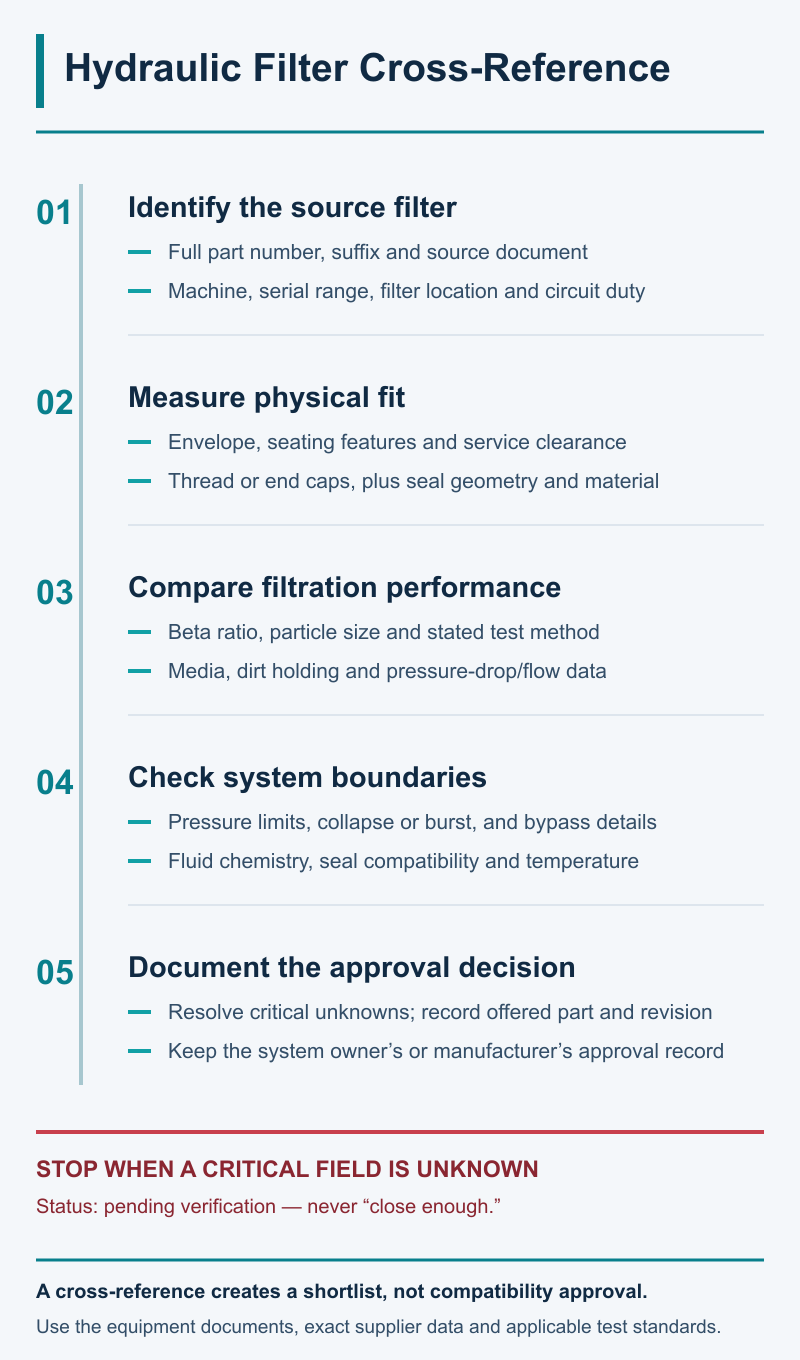
A cross-reference has to survive five checks
Give every check one of three outcomes: accepted, rejected or pending. A blank cell means pending. It never means “close enough.”
1. Identify the source filter and the job it does
Start with the complete number from the installed filter, current equipment manual or approved bill of materials. Keep every prefix, suffix, revision letter and punctuation mark. Record the machine model, serial range, filter location and whether the circuit is suction, return, pressure, case drain, charge or offline. One machine can use near-identical filters for completely different duties.
Identify the construction as well: spin-on assembly, replacement element for a housing or another form. Add the source document, revision and retrieval date to the record. A handwritten storeroom label can start the search; the current OEM record is stronger evidence.
2. Prove the physical interface
Use a part-specific drawing when one is available. For a spin-on filter, compare overall length, body outside diameter, mounting-seat geometry, thread designation and pitch, gasket outside and inside diameters, gasket profile and service clearance. For an element, add end-cap form, inside diameters, locating features, seating direction and any feature that prevents bypass around the element.
Then check the supplied seal material against the actual fluid and temperature range. Seal color is not a material specification. If the filter starts on the thread and fits inside the available envelope, it has passed only the physical-fit part of the review.
3. Put the filtration data on the same basis
A micron number by itself names a particle size; it does not state removal efficiency. Ask for the Beta ratio at a stated size and the test method. ISO 16889:2022 describes a multi-pass test for hydraulic filter elements that evaluates particulate removal, contaminant capacity and differential-pressure characteristics. The “(c)” particle-size notation is associated with particle-counter calibration under ISO 11171:2022.
Carry the media type, contaminant-holding capacity, test flow and terminal differential pressure with the Beta result. Then compare pressure-drop-versus-flow data for the exact element at a viscosity relevant to the system. Cold oil, a loaded element and the housing passages all add restriction. The Parker Handbook of Hydraulic Filtration shows why multi-pass performance, dirt holding and differential pressure belong in the same discussion.
4. Check every system limit separately
Keep pressure terms in separate fields: maximum system operating pressure, transient pressure, housing working pressure, element collapse differential, spin-on burst value and filter differential pressure describe different limits. A documented housing rating cannot be copied into the element column. Flow direction and element support also have to match the housing design.
Map the bypass next. Record whether it sits in the element, spin-on can, head or elsewhere; whether the candidate includes it; the documented opening specification, tolerance and flow direction; or the system's documented no-bypass requirement. The actual fluid, minimum start-up temperature, maximum operating temperature and viscosity range complete this gate. Media, adhesive, seals, end caps and coatings all need compatible limits from their manufacturer.
5. Record the target and who can approve the change
Compare the candidate with the machine's required cleanliness target, monitoring method, contamination load and service policy. ISO 4406:2021 supplies a code for reporting solid-particle contamination; it does not select the target for a machine or prove that one filter will maintain it.
Finish the record with the exact offered part number, every evidence source and revision, the unresolved fields, and the person or organization allowed to accept the interchange. One critical unknown keeps the result at pending. Purchasing may still ask for price and lead time. Technical approval waits.
Read the Beta ratio before trusting the micron claim
The Beta ratio compares upstream and downstream particle counts in equal fluid volumes at or above a stated size. For a calibrated particle size, it is commonly written as βₓ(c):
βₓ(c) = upstream count at or above x µm(c) ÷ downstream count at or above x µm(c)
If equal test volumes contain 200 qualifying particles upstream for every one downstream, βₓ(c) is 200 at that size.
Efficiency can be expressed as:
Efficiency = (1 − 1 / βₓ(c)) × 100%
That makes Beta 75 about 98.7% efficient and Beta 200 about 99.5% efficient at the stated particle size. These are mathematical conversions, not performance claims for an OXELR product. The Donaldson Hydraulic Filtration Overview publishes the same relationship and also notes that ISO 16889 results depend on the tested configuration and conditions.
Keep the particle size, Beta value, test method and relevant conditions together. Once separated from that context, “absolute” and “nominal” are too vague to support a controlled interchange.
For HF35498, leave the unknowns where everyone can see them
The HF35498 hydraulic filter listing can identify the candidate being discussed, but a supplier listing is not a substitute for a current, part-specific manufacturer or equipment-OEM document. Until that evidence is attached, keep the numerical specifications out of the verified column.
| Verification field | Evidence to attach | Status until received |
|---|---|---|
| Exact part identity, manufacturer and product form | Current manufacturer or equipment-OEM record for the exact number | Pending |
| Outside diameter, length and service envelope | Part-specific manufacturer drawing or datasheet | Pending |
| Thread and sealing interface | Manufacturer drawing with thread designation, pitch and seat details | Pending |
| Gasket geometry and material | Part-specific gasket dimensions and material compatibility statement | Pending |
| Beta performance, media and contaminant capacity | Part-specific test data with particle size, Beta value and test basis | Pending |
| Pressure drop, structural limits and flow direction | Part-specific curves and clearly named ratings | Pending |
| Bypass arrangement and setting | Part-specific valve location, opening specification and tolerance, or documented no-bypass design | Pending |
| Fluid and temperature limits | Manufacturer compatibility and operating-limit data | Pending |
Values copied from the OXELR page can travel with an RFQ as supplier-listed, pending verification, provided the source and retrieval date stay attached. They become verified only when the responsible manufacturer, equipment OEM or qualified system owner supplies acceptable evidence. Use the same rule for another candidate such as the 0850R025W-HC hydraulic filter. A similar name or neighboring catalog entry cannot fill a missing field.
Build one record that purchasing and maintenance can share
Start with the exact source number and application. Then use a catalog or the broader hydraulic filter range to find candidates. Put the original requirement, candidate value, evidence link and outcome beside one another. Write pending in an unresolved cell so the next person can see exactly where the comparison stopped.
Physical inspection can confirm measurements, seal seating and clearance after the equipment has been made safe. It cannot establish filtration efficiency or pressure capacity. Any installation trial belongs inside the equipment owner's approved procedure. Save the comparison and authorization with the maintenance record so the next shift does not have to reconstruct the decision.
To get an answer that purchasing and maintenance can actually use, include:
- Full source part number, photographs and source document.
- Machine model, serial range, filter location and circuit duty.
- Required dimensions, connection and seal details.
- Beta rating and particle size with the required test basis.
- Fluid, minimum and maximum temperatures, flow and viscosity information supplied by the system owner.
- Operating, transient and differential-pressure requirements, clearly labeled.
- Bypass location and required setting.
- Requested quantity, packaging, documentation and sample or approval process.
You can send a filter RFQ with that information. A complete request lets the supplier separate what is documented from what is unavailable or still needs engineering confirmation.
Settle the loose ends before the purchase order
Are matching thread and gasket dimensions enough? No. They establish only part of the physical fit. The candidate stays pending until filtration efficiency, media, pressure drop, structural limits, bypass arrangement, fluid compatibility and temperature range have been matched to the system requirements.
A micron value names a particle size; a Beta ratio states removal performance at a particular size under a defined test method. Without efficiency and test context, a micron claim cannot support a controlled comparison.
If the candidate data omits the bypass setting, first establish whether the bypass sits in the element, spin-on can, head or somewhere else. Then obtain both the required and offered settings. The cross-reference number does not answer that question, so the check remains pending.
A supplier or competitor table can build the shortlist and preserve useful identifiers. It cannot give final approval. That requires the application requirements, part-specific manufacturer evidence and the authorization called for by the equipment owner's process. Repetition across catalogs is not confirmation.
Apply this guide to your enquiry
Need help matching the filter behind this topic?
Send the installed reference, clear photos or dimensions, application, quantity, and destination country for review before quotation.